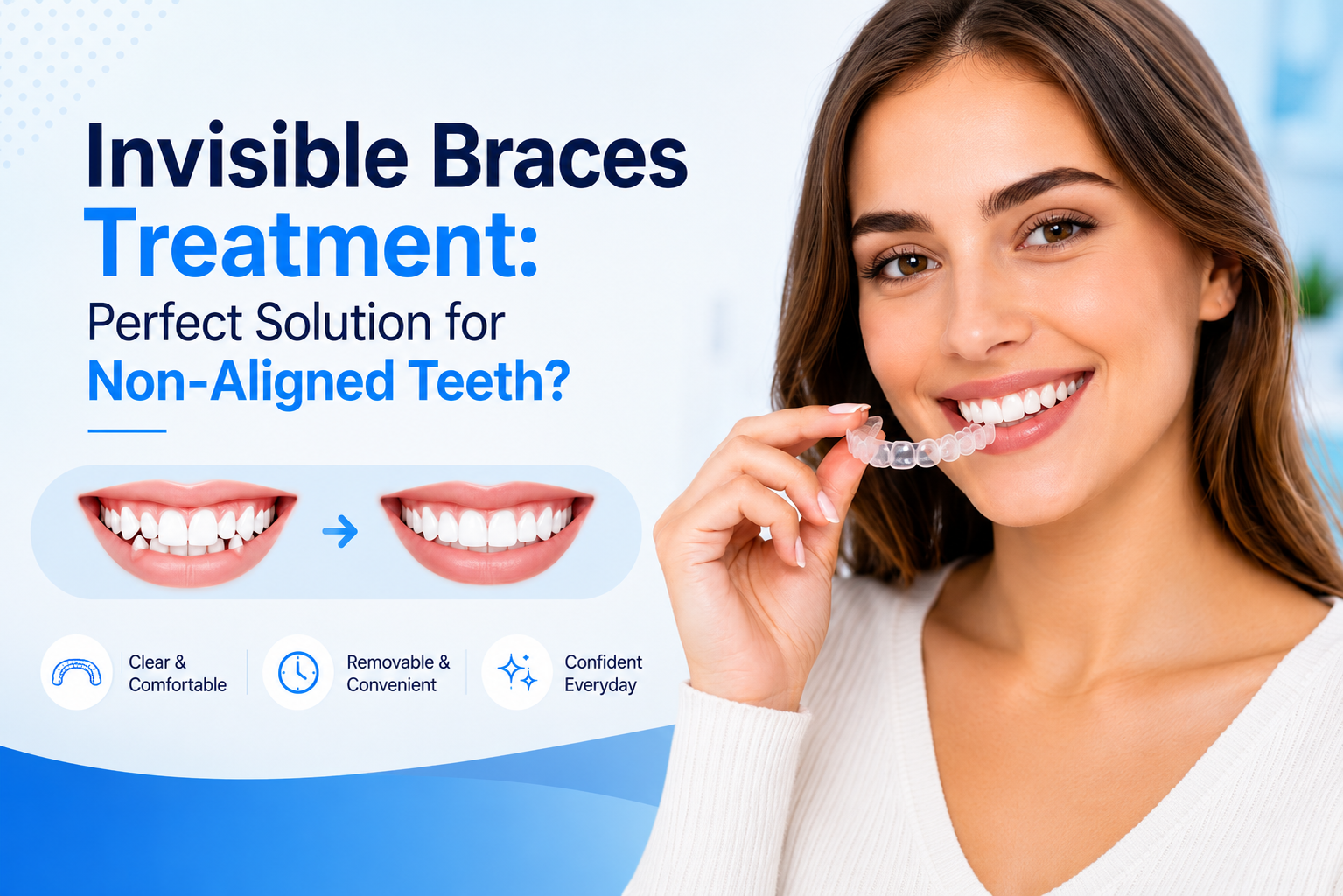
Invisible Braces Treatment: The Perfect Solution for Misaligned Teeth?
A beautiful smile can make a strong difference in the way a person looks, speaks, and feels. But when teeth are crooked, crowded, spaced, or not properly aligned, many people feel less confident about smiling openly. Earlier, metal braces were the most common option for correcting non-aligned teeth. Today, invisible braces treatment has become a popular choice for people who want straighter teeth without the noticeable appearance of traditional braces.
Invisible braces usually refer to clear aligners, which are transparent, removable trays made to fit over the teeth. Some people also use the term for clear or ceramic braces, which work like traditional braces but are less visible. According to the American Association of Orthodontists, clear aligners are thin, plastic-like trays that apply gentle pressure to teeth and gradually move them into better positions. They are commonly worn for around 22 hours a day and changed in stages as the teeth move.
What Are Invisible Braces?
Invisible braces are orthodontic appliances designed to straighten teeth in a more discreet way. Unlike metal braces, which use visible brackets and wires, invisible braces are made to blend with the natural appearance of the teeth.
The most common type is clear aligners. These are custom-made trays that fit over the teeth. Patients receive a series of aligners, and each set is designed to move the teeth little by little. After wearing one set for a specific period, the patient moves to the next set.
Another option is clear braces or ceramic braces. These are fixed braces, but the brackets are tooth-coloured or transparent, making them less noticeable. Cleveland Clinic explains that clear braces work in a similar way to metal braces and can correct problems such as crooked, crowded, gapped, and overlapped teeth.
How Invisible Braces Work
Invisible braces work by applying controlled pressure to the teeth. This pressure encourages the teeth to move slowly into the correct position. In the case of clear aligners, the dentist or orthodontist first checks the patient’s teeth and bite. Digital scans, X-rays, or impressions may be taken to create a personalised treatment plan.
Once the treatment plan is ready, a series of aligners is made. Each aligner is slightly different from the previous one. As the patient wears them, the teeth gradually shift. The American Association of Orthodontists notes that each set of aligners may be worn for around one to three weeks, depending on the treatment plan.
The success of invisible braces depends greatly on patient discipline. Since clear aligners are removable, they must be worn for the recommended number of hours every day. If the patient removes them too often or forgets to wear them, the treatment may take longer or may not give the expected result.
Why People Choose Invisible Braces
One of the biggest reasons people choose invisible braces is appearance. Many adults and teenagers want to straighten their teeth but do not want visible metal brackets. Invisible braces allow them to continue their daily life, work, college, meetings, and social events with more confidence.
Clear aligners are also removable. This means patients can take them out while eating, drinking anything other than water, brushing, and flossing. This makes oral hygiene easier compared to fixed braces. With traditional braces, food particles can easily get stuck around brackets and wires. But with clear aligners, patients can brush and floss normally after removing the trays.
Comfort is another major benefit. Clear aligners are made from smooth plastic, so they usually cause less irritation to the cheeks and gums than metal brackets. However, some pressure or mild discomfort is normal when a new set of aligners is worn because the teeth are starting to move.
Teeth Problems Invisible Braces Can Correct
Invisible braces can help correct many common alignment problems. These include crooked teeth, crowded teeth, gaps between teeth, slightly rotated teeth, and mild to moderate bite issues. They may also help with overbite, underbite, crossbite, or open bite in selected cases.
However, invisible braces are not suitable for every dental problem. Some complex cases may need traditional braces, additional appliances, or a combined orthodontic approach. The American Association of Orthodontists clearly notes that some, but not all, orthodontic problems can be treated successfully with clear aligners.
This is why a professional consultation is very important. A dentist or orthodontist can examine the teeth, jaw, gums, and bite before recommending the right treatment.
Invisible Braces vs Traditional Braces
Both invisible braces and traditional braces aim to straighten teeth and improve bite alignment. The main difference lies in appearance, comfort, removability, and suitability.
Traditional metal braces are fixed to the teeth. They are very effective for mild, moderate, and complex orthodontic problems. Since they cannot be removed by the patient, they work continuously. This can be helpful for children or patients who may not remember to wear aligners properly.
Invisible braces, especially clear aligners, are more discreet and removable. They are often preferred by adults and working professionals. They allow easier eating and cleaning, but they require strong commitment. If the aligners are not worn as instructed, results can be affected.
Clear braces sit between these two options. They are fixed like metal braces but less visible because of their tooth-coloured or clear brackets. They may be a good choice for people who want a discreet option but also need fixed orthodontic control.
Treatment Process for Invisible Braces
The treatment usually begins with a consultation. During this visit, the dentist or orthodontist checks the teeth and discusses the patient’s concerns. If invisible braces are suitable, digital scans or impressions are taken.
Next, a customised treatment plan is created. This plan shows how the teeth will move and how long the treatment may take. Once the aligners are ready, the patient receives the first few sets and instructions on how to wear and clean them.
Patients usually need to wear aligners most of the day and night, removing them only while eating, drinking, brushing, and flossing. Regular follow-up appointments are needed to check progress. After the active treatment is complete, retainers are usually given to maintain the new tooth position.
Retainers are very important. Teeth can slowly shift back if retainers are not worn as advised. Many patients make the mistake of thinking treatment ends when the aligners are finished. In reality, retention is a key part of long-term success.
How Long Does Invisible Braces Treatment Take?
The treatment duration depends on the complexity of the case. Mild spacing or minor crowding may take a few months. More moderate alignment issues may take one year or longer. Severe cases may need a longer period or a different treatment method.
Factors that affect treatment time include the amount of tooth movement required, the patient’s age, oral health condition, bite issues, and how consistently the patient wears the aligners. Good compliance can help the treatment stay on track, while irregular wear can delay results.
Are Invisible Braces Painful?
Invisible braces are not usually painful, but patients may feel mild pressure or soreness, especially when they start a new aligner set. This is a normal sign that the teeth are moving. The discomfort usually reduces after a few days.
Patients may also experience slight speech changes at the beginning. Some people may notice a minor lisp while speaking with aligners, but this usually improves as the mouth adjusts.
If there is severe pain, gum injury, or poor fit, the patient should contact the dentist or orthodontist. Aligners should feel snug, but they should not cause serious discomfort.
How to Care for Invisible Braces
Proper care is essential during invisible braces treatment. Aligners should be cleaned daily to prevent stains, odour, and bacteria build-up. Patients should rinse them after removal and clean them as advised by the dentist.
Eating while wearing clear aligners should be avoided because food can damage or stain them. Drinking hot beverages with aligners can also affect their shape. Water is usually safe, but tea, coffee, soft drinks, and coloured drinks can stain the trays.
Good oral hygiene is also important. Patients should brush and floss before putting the aligners back in. If food particles remain trapped between the teeth and aligners, it can increase the risk of cavities and bad breath.
Cost of Invisible Braces Treatment
The cost of invisible braces varies from patient to patient. It depends on the complexity of the case, treatment duration, type of aligner system, clinic location, dentist or orthodontist experience, and whether additional procedures are needed.
In general, invisible braces may cost more than basic metal braces in some clinics, especially if advanced digital planning or branded aligner systems are used. However, many patients consider the comfort, appearance, and convenience worth the investment.
Before starting treatment, patients should ask for a clear cost breakdown. This should include consultation, scans, aligners, follow-up visits, refinements, and retainers.
Are Invisible Braces Safe?
Invisible braces are generally safe when planned and monitored by a qualified dental professional. However, orthodontic treatment should not be taken casually. Moving teeth without proper diagnosis can create problems with the bite, gums, roots, or jaw.
The FDA has also advised patients to consult dental professionals if they have concerns with dental devices, especially because some devices used for jaw or dental changes may carry risks when not properly evaluated.
This makes professional supervision very important. A low-cost or unsupervised aligner option may look attractive, but it may not be suitable for every patient.
Are Invisible Braces Safe?
Invisible braces are generally safe when planned and monitored by a qualified dental professional. However, orthodontic treatment should not be taken casually. Moving teeth without proper diagnosis can create problems with the bite, gums, roots, or jaw.
The FDA has also advised patients to consult dental professionals if they have concerns with dental devices, especially because some devices used for jaw or dental changes may carry risks when not properly evaluated.
This makes professional supervision very important. A low-cost or unsupervised aligner option may look attractive, but it may not be suitable for every patient.
Invisible braces treatment can be an excellent solution for non-aligned teeth, especially for people who want a discreet, comfortable, and modern way to improve their smile. Clear aligners are removable, nearly invisible, and convenient for daily life. Clear braces are also a good choice for patients who want a less noticeable fixed orthodontic option.
However, invisible braces are not a perfect solution for everyone. Their success depends on proper case selection, professional planning, regular monitoring, and patient discipline. For mild to moderate alignment problems, they can give excellent results. For complex bite or jaw issues, traditional braces or other orthodontic treatments may be more suitable.
The best way to know whether invisible braces are right for you is to consult an experienced dentist or orthodontist. With the right guidance and consistent care, invisible braces can help you achieve a straighter, healthier, and more confident smile.
Looking for the Best Orthodontist in Pune?
Looking for the Best Orthodontist in Pune? Dr. Shibli Syed offers advanced orthodontic care at FDOC with personalised solutions for braces, clear aligners, and smile correction. His clinic highlights clear aligners as a modern, comfortable option for straightening teeth without metal wires, using customised trays to gently move teeth into alignment. FDOC also has multiple Pune locations, including Kasba Peth, Camp, and Salisbury Park, making expert dental care more accessible. Choose Dr. Shibli Syed for a confident, healthier, and well-aligned smile.